AI assisted coding doesn’t just change how we develop software. It, necessarily, changes how we have to manage software development; daily standups where the focus is on the story you’ll work on today seem quaint when most developers are finishing 3 or 4 stories each day, teams make too much progress to only demo every other week, AI assistants require more detail in user stories, the list goes on and on. At Kyndryl we’ve developed a model we call “Orchestrated Delivery” to manage these new projects. Among the lessons that have stuck for us:
- The bottleneck moved to “what’s next.” Our AI-powered Product Owners write user stories faster than ever, and our AI-powered developers knock them out faster than ever. The scarce resource is no longer typing — it’s a clean, well-prioritized queue of shovel-ready tasks waiting for a developer (human or otherwise) to pick up. Get that right and you don’t need three standups a day to keep everyone busy; you get developers who are three times as effective because they’re never waiting on a decision.
- Testing became a feature of every story. When tests are this cheap to write, “nearly complete coverage” stops being aspirational and starts being the baseline. We’ve got guardrails about who writes the tests and how we use AI to write them — mostly so a single hallucination doesn’t quietly corrupt the code and the test that’s supposed to catch it.
- Create context. When humans are building software they can often infer context. When AI assistants are doing the build, they start each session from scratch. Stories need to have context.
Notice what those lessons have in common: they’re really all about coordination at scale — keeping a lot of people and a lot of agents productive and pointed in the same direction. My coding in the evening has an entirely different set of challenges.
Agentic Management of Me
I’m a team of one. comites.ai and my little stable of personal agents get built in the cracks — the early-morning hour before the day starts, a weeknight after dinner, a slow Sunday. The surprising part is how many of those same lessons still apply — but the thing I’m optimizing for flips completely. I’m not trying to keep a dozen developers fed. I’m trying to solve two problems a big team never has:
- Help me find the time. My development priorities have to live right next to my long run and “take out the recycling,” or the spare hour quietly evaporates. Visibility matters far more than careful prioritization.
- Let me jump straight in with all the context. When I do get twenty minutes, I can’t afford to spend them remembering where I left off. I need to drop in and immediately know what I’m doing and, just as importantly, why.
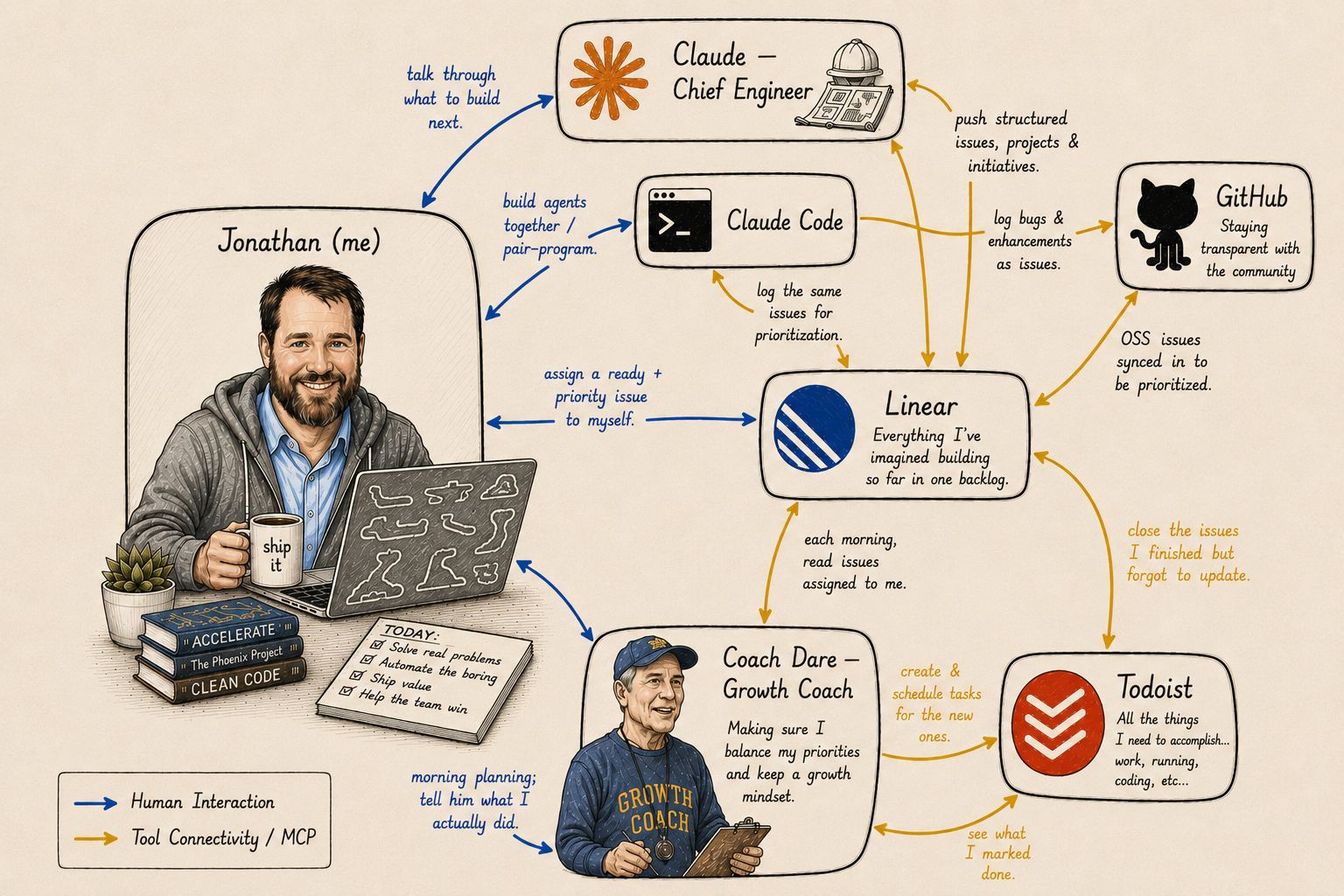
So I bent those same three ideas toward those two goals, using tools I already live in — a real backlog in Linear, my daily list in Todoist, and my open-source projects on GitHub — with a couple of Claudes and my Growth Coach as the connective tissue. I can share a lot more about how I do this at home than I can about how we do it at Kyndryl. You can see from the diagram above, that it’s quite the system:
- GitHub — the open-source work. I’m calling this out as a node in the diagram not for source code management and version control but for being the public source of truth on the OSS portions of comites.ai (the Forum and the Agent Template) — the projects other people actually run on their own. GitHub Issues (and Actions) give those folks transparency into what I’m fixing and building. Every issue I open there also gets pushed into Linear, so it can be prioritized against everything else and, where it makes sense, folded into a bigger project or initiative.
- Linear — my system of record. I use linear to manage my backlog. Every idea I have goes into linear as an issue or project over time they either get prioritized, lumped into a larger release, or removed.
- Claude — my Chief Engineer. (Yes, he has a seat on the team.) I’ll have a long, rambling conversation with Claude about what to build next for an agent or one of the comites.ai products. When one of those turns into something I actually want to do, Claude uses his Linear connector to push the whole structured set — issues, projects, initiatives — straight in to my backlog.
- Claude Code — my bug-and-enhancement spotter. A surprising amount of what lands on the Forum or the Template starts as something I trip over while building one of my own agents — something broken, or just clunky. When that happens, Claude Code logs it in the right place (Linear, GitHub, or both) without making me break stride on whatever I was actually doing.
- Todoist — my whole life. Here’s the real trick. I now have a list of things I want to develop in linear, but how does the time to build it surface on a random Tuesday? That’s where Todoist comes in… every task lives here… whether it’s a comites.ai issue, a marathon workout, or mowing the lawn. When a Linear issue is genuinely ready to build and it’s a priority, I assign it to myself, and the growth coach automatically picks it up and brings it into Todoist.
- Coach Dare — my Growth Coach. He’s the glue, and he does two jobs here:
- Keeps Linear and Todoist in sync. Every morning he reviews the issues assigned to me, creates Todoist tasks for the new ones, and — because I’m human — quietly closes out anything in Linear I marked done in Todoist but forgot to update.
- Schedules the work into a real day. Exactly like he does with the rest of my life, he slots my comites.ai backlog into the days and times I can actually work on them — instead of letting it hide in a tool I have to remember to open.
What this looked like last night
Let me show you an actual loop from a recent night. On my list — prioritized in Linear, copied to Todoist by Coach Dare — was a fix for the Growth Coach himself: he’d been creating duplicate scheduled reminders (it got so bad that one morning last week he tried to checkin with me 7 times! I thought this would be a simple fix in the growth coach, but it turned into more:
- The task I picked up: an agent-side fix — stop identifying users the wrong way, use a stable name for each distinct reminder, and rip out a “reconcile every Sunday” loop that turned out to be breeding the duplicates in the first place.
- The detour: while I was in there, it became obvious the real culprit lived a layer down, in the Forum’s scheduler itself.
- The culprit — Claude Code and I discovered that the Scheduler’s MCP server poorly described which form of a user’s identity it would look up scheduled jobs based on. Then, when the coach thought a job was missing and scheduled another job it wasn’t idempotent.
- Exposing the Bug Publicly – Since I am sharing the Forum as an Open Source project because I want people to benefit from what I’ve learned about using agents, I want to make sure I’m providing traceability to changes I make on it. So I had Claude create BOTH GitHub issues and Linear issues for the work that needed to be done to fix the forum.
- The close-out: I fixed the issues and merged the change and this morning Coach only pinged me once! Claude also knew to close out the Linear issues and the Todoist tasks.
By day, the thing I’m fighting is coordination drag across a big team. By night, it’s the blank-stare moment when I finally have a free hour and can’t remember where I left off. Same playbook — keep the intent attached to the work, keep a shovel-ready queue, let the robots handle the bookkeeping — just re-pointed at a team of one. Either way, the goal is making sure the time counts!